Handcrafted with Bengal’s heart, designed for modern living.

Murshidabad: Where Architecture Becomes Memory
A nostalgic journey through the architectural heritage of Murshidabad, seen through the eyes of writer Anurupa Acharya and her childhood memories in Beldanga. From the grandeur of Hazarduari and historic mansions to mango groves, Harimati School, and the harmonious echoes of azaan and temple bells, the article explores how architecture shapes identity and memory. More than a study of buildings, it is a personal tribute to a landscape where history, culture, and belonging intertwine.
ARCHITECTURE OF BENGAL
Anurupa Acharya
5/25/20264 min read
Murshidabad: Where Architecture Becomes Memory
By Anurupa Acharya
Some places are known through history books, and some are known through memory. Murshidabad, for me, belongs to the latter. My maternal home—my mamar bari—is in Beldanga, and much of my childhood was spent in the quiet embrace of this historic district. Long before I understood the significance of nawabs, palaces, and colonial architecture, I knew Murshidabad through mango groves, old mansions, temple bells, and the distant call of the azaan floating through the evening air.
When people speak of Murshidabad, they often think of royal grandeur—the thousand doors of Hazarduari, the wealth of the Jagat Seths, the splendour of forgotten courts and aristocratic households. Yet for me, Murshidabad is not merely a destination of monuments. It is a landscape where architecture and memory are inseparable.
My earliest recollections are filled with endless summer afternoons spent wandering through mango orchards. The great trees stood like silent sentinels, their sprawling canopies creating a world of shade and imagination. Beyond the groves lay old lime-washed houses, their thick walls stained by time and monsoon rains. Their courtyards echoed with stories of generations long gone. Every cracked cornice, every wooden shutter, every moss-covered veranda seemed to carry a history that no textbook could ever fully capture.
The architecture of Murshidabad is unique because it reflects centuries of cultural exchange. Once the capital of Bengal, it was a meeting ground of Mughal elegance, Bengali craftsmanship, Persian influences, and later, European tastes. The result is an architectural landscape unlike any other in Bengal.
No discussion of Murshidabad's architecture can begin without Hazarduari Palace. Its imposing façade, grand halls, towering columns, and legendary thousand doors stand as a reminder of a city that once commanded immense wealth and influence. The palace represents a fascinating blend of European neoclassical design and the legacy of Bengal's Nawabs. Walking through its corridors, one cannot help but feel the weight of history.
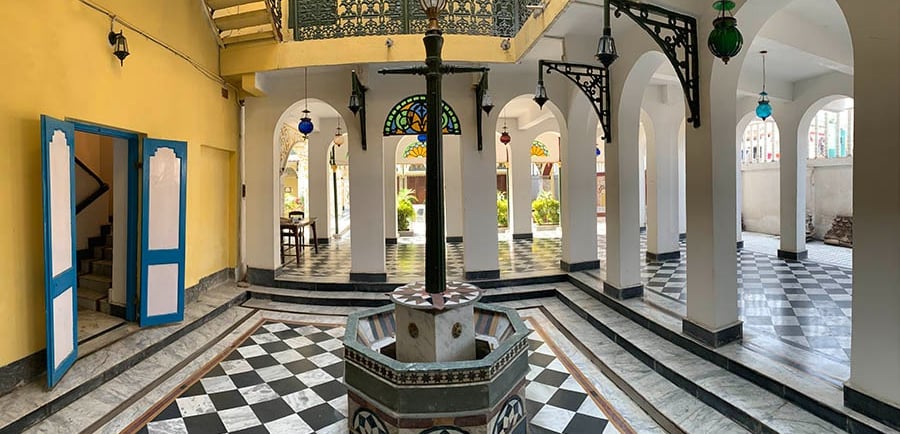
Yet the soul of Murshidabad lies not only in its famous landmarks but also in its quieter structures. The old mansions scattered across towns and villages tell stories of zamindars, merchants, scholars, and families whose lives shaped the region. Many of these houses, though weathered by time, retain an elegance that modern architecture often struggles to recreate. Their high ceilings, long verandas, ornamental railings, and spacious courtyards were designed not merely as buildings but as spaces for living, gathering, and storytelling.
Among the places that remain vivid in my memory is Harimati School. Like many heritage institutions in Bengal, it possessed a dignity born not of grandeur but of continuity. Generations passed through its classrooms, and its architecture reflected a time when buildings were created to endure. The long corridors, open spaces, and simple symmetry spoke of an era when education itself was considered a lasting legacy.
What makes Murshidabad truly remarkable, however, is its cultural harmony. In Beldanga, the sounds of daily life created a rhythm that remains etched in my memory. At dusk, the azaan from a nearby mosque would rise into the evening sky. Almost simultaneously, the bells of Burima Kaali's temple and the ancient shrine of Buro Shib would ring out. These sounds never competed; they coexisted naturally, forming the soundtrack of a shared heritage. The architecture of Murshidabad reflects this coexistence. Mosques, temples, shrines, and mansions stand side by side, each contributing to the identity of the region.
The district's architectural heritage extends beyond religious and residential structures. The old sugar mill remains one of the enduring symbols of Murshidabad's industrial history. For many of us growing up in the region, it was more than a factory—it was a landmark, a marker of place and memory. Equally significant is Berhampur Central Jail, a structure that occupies an important place in Bengal's historical narrative. Its walls have witnessed moments of political upheaval, colonial rule, and the struggle for freedom. These buildings may not possess the ornamentation of palaces, but they are integral chapters in Murshidabad's architectural story.
Murshidabad's architecture is also deeply connected to craftsmanship. The region's celebrated silk industry, its traditional artisans, metal workers, and craftsmen all contributed to the creation of spaces that were both functional and beautiful. Decorative plasterwork, carved wood, ornamental ironwork, and intricate detailing transformed ordinary structures into expressions of cultural identity.
What strikes me most whenever I return is the colour of memory itself—the soft white of lime-washed walls glowing under the afternoon sun, the deep green of mango orchards after the monsoon, the earthy red of old pathways, and the golden light that settles over ancient buildings at dusk. These are not merely visual impressions; they are emotional landscapes that define Murshidabad for those who have loved it.
Today, many of these structures face the challenges of neglect, urbanisation, and time. Some have disappeared altogether. Yet the spirit of Murshidabad endures. It survives in stories told by grandparents, in festivals celebrated by communities, in old photographs preserved in family albums, and in the architecture that continues to stand against the passage of years.
For me, Murshidabad is not simply a district on a map. It is a place where history walks beside memory. It is the fragrance of mango blossoms in summer, the echo of footsteps in old corridors, the harmony of azaan and temple bells, the sight of lime-washed mansions fading gracefully into the landscape. It is a reminder that architecture is not merely about buildings; it is about the lives they shelter, the stories they witness, and the memories they preserve.
In an age of rapid change, Murshidabad remains a testament to Bengal's layered identity. Its palaces, schools, temples, mosques, mansions, mills, and public institutions together create a living archive of the past. To walk through Murshidabad is to journey through history, but more importantly, it is to encounter the enduring power of memory.
And perhaps that is why I keep returning—not merely to admire its architecture, but to rediscover the fragments of myself that still linger among its mango groves, its old houses, and its timeless skies.
Brand
Explore our sleek website template for seamless navigation.
Contact
Newsletter
MOBILE- 9903585471
© 2024. All rights reserved.