Handcrafted with Bengal’s heart, designed for modern living.

Launching of Charu Kalyan Kobipokkho Collection on 25th Baisakh
Inspired by the timeless poetry, songs, and artistic vision of Rabindranath Tagore, the Kobipokkho Collection by Charu Kalyan is a sustainable range of home décor and furnishings that celebrates Bengal’s literary heritage. Handcrafted by rural women artisans, the collection transforms traditional textiles, handloom fabrics, and indigenous crafts into elegant contemporary pieces, bringing the spirit of Tagore’s world into modern homes through thoughtful design, craftsmanship, and cultural storytelling.
Anurupa Acharya
5/3/20262 min read
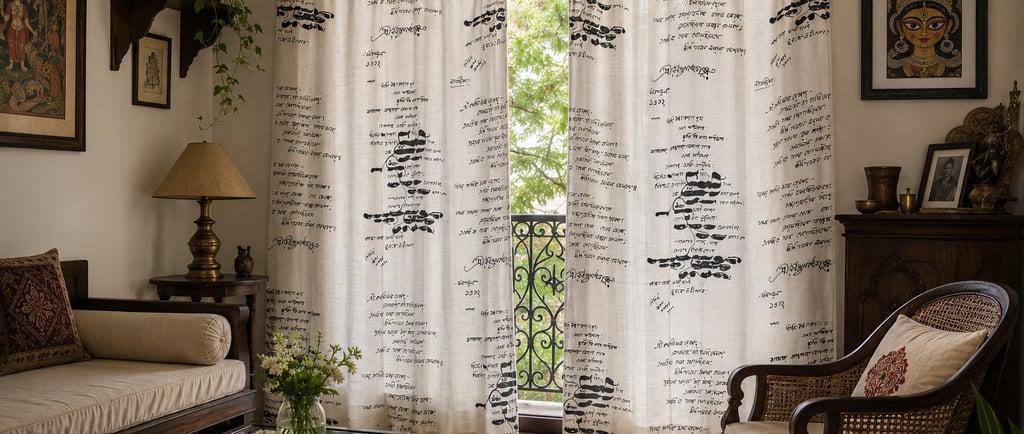
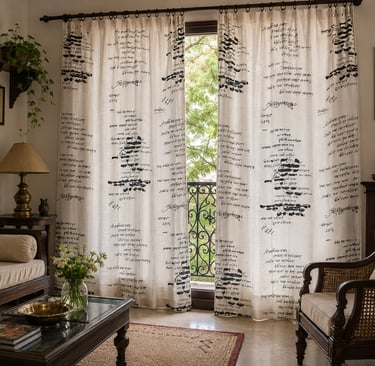
'Kobipokkho' by Charu Kalyan: Featuring Rabindranath Tagore’s Scripts into Textile Art
Every year, the arrival of Kobipokkho brings with it an atmosphere of poetry, music, nostalgia and quiet introspection across Bengal. It is not merely a celebration of the birth of Rabindranath Tagore; it is a celebration of an entire cultural consciousness shaped by literature, art, craft and philosophy. Inspired by this timeless legacy, Charu Kalyan presents the Kobipokkho Collection — a series of handcrafted home furnishing textiles that transform Tagore’s handwritten scripts and visual language into living textile art.
The collection is deeply rooted in the spirit of the Bengal Renaissance, a movement that redefined art, education and identity in Bengal during the nineteenth and early twentieth centuries. At the centre of this cultural awakening stood Rabindranath Tagore — poet, philosopher, educator, painter and visionary — whose ideas transcended conventional boundaries. Through literature, music, theatre and visual art, Tagore sought harmony between human life, nature and creativity. His works were not meant to remain confined within books or galleries; they were meant to become part of everyday existence.
This philosophy found one of its most remarkable expressions in Santiniketan and later Visva-Bharati, where Tagore created an educational environment that merged learning with art, craft, nature and freedom of expression. The Santiniketan school of art, guided by masters like Nandalal Bose, Benode Behari Mukherjee and Ramkinkar Baij, developed a distinctly Indian modernism rooted in indigenous aesthetics, handcraft traditions and simplicity. Their visual language embraced natural forms, folk traditions, handwritten texts, mural art and organic textures — elements that continue to inspire artists and designers even today.
The Charu Kalyan Kobipokkho Collection draws from this very ethos. The curtains, cushions and textile surfaces become canvases where Tagore’s handwritten Bengali scripts flow across fabric like visual poetry. His distinctive calligraphic style — spontaneous, fluid, meditative and deeply expressive — is reinterpreted as textile motifs through handcrafted processes. The handwritten words no longer remain only literary expressions; they evolve into textures, rhythm and movement within the fabric itself.
In many ways, Tagore’s handwriting carries the same emotional depth as his poetry. The curves, pauses and ink flows possess an abstract beauty that resembles modern art. Our collection celebrates this unique aesthetic by allowing script to exist beyond language — as form, pattern and atmosphere. Each textile becomes a dialogue between literature and interior space, transforming a home into a quiet cultural experience.
The use of natural textures and handloom-inspired surfaces in the collection further reflects the ideals of the Bengal School and Santiniketan craft traditions. Rather than pursuing excessive ornamentation, the designs embrace restraint, earthiness and authenticity. The monochromatic script compositions create a striking visual balance that feels simultaneously traditional and contemporary, making the collection suitable for both modern and heritage-inspired interiors.
At Charu Kalyan, we believe that home furnishings can carry memory, philosophy and identity. The Kobipokkho Collection is therefore not simply a decorative range; it is an artistic homage to Bengal’s literary and cultural heritage. It celebrates the idea that art belongs within daily life — in the folds of curtains touched by morning light, in the quiet corners of a room, and in the textures that surround us every day.
Through this collection, Tagore’s words once again find a home among people — not only to be read, but also to be lived with.
Brand
Explore our sleek website template for seamless navigation.
Contact
Newsletter
MOBILE- 9903585471
© 2024. All rights reserved.